



Laura Seth, FA performance analysis and insights manager, provides her top tips for improving observation skills on matchday and at training.
Think about your philosophy
Think about your coaching philosophy or club's playing philosophy and link your observations to them. So, when you're observing, keep in mind how you want your team to play when you have and haven't got the ball, and what that might look like in different areas of the pitch.
Everyone has their own beliefs and values in terms of how they want their team to play or are working within a club framework, so that's your starting point.
Define success and failure
You've got to take a step back and, before the observation, define what success and failure is. For example, a wide player is attacking your full back. Do you want your full back to show inside or outside? If they're showing the player inside and you want them to show outside, that flags an area that might help you develop some practices for them. You can then teach them about their angle of approach and their body position to force the player outside.
It's not easy; you're still caught up in the heat of the game. But if you have a logical framework and process to it – and you're really clear on what certain things look like – you'll cope better with more pressurised moments.
Make notes
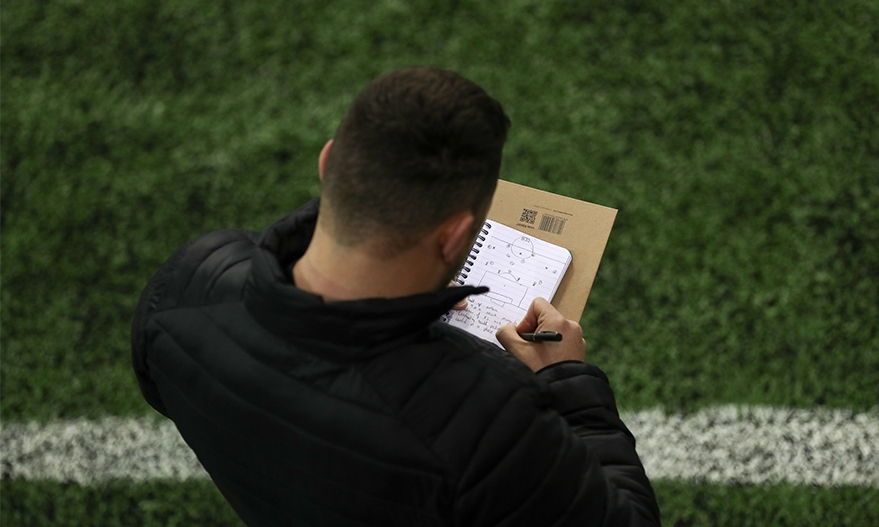
Don't discount the reliable pen and paper for making notes – jot down things that are happening or get someone else to make those notes for you.
We've all got the capability to capture something through a phone or tablet. Everyone has these in their pockets now. Using technology, as well as maximising the resource of people that you've got around you, can help at all levels of the game.
Keep it simple
It's a well-known saying but just keep it simple. If you're observing your own team and what you're working on, focus on the two or three key things that you want your team to be able to do to be successful.
If you're studying the opposition, it can be as simple as: how are they scoring goals? How are they conceding goals? How are they creating chances? How are they conceding chances? As opposed to being overwhelmed by trying to take in absolutely everything.
Work as a team
Breaking it down into a more logical or structured approach will help massively with what you can do, but so will maximising the fact that it doesn't have to be all on you.
Our national teams utilise this approach. There'll be someone focusing on the team in possession, someone else focusing on the team out of possession and someone else focusing on set pieces. They tell the head coach the two key things they've seen, and the head coach then delivers the messages to the players at half-time.
Whether it's an assistant coach, your substitutes, an injured player or even a parent who helps you, this approach will allow you to better understand and evaluate what you're observing.
Be aware of emotions
Be aware that there are a lot of things that can affect your interpretations. As human beings we're incapable of processing large volumes of information – we're more likely to remember a contentious decision made by the referee a couple of minutes before half-time, a mistake that led to a goal or a brilliant bit of play that led to a goal.
It's also really easy to have a distorted view because you're so heavily involved and invested in the game. It can be challenging to then deliver an effective intervention because of your emotion and passion for wanting the players to do well.
As long as the people you're working with have clear instruction of what's going to help you in that particular moment, they'll be a massive help because you do get caught up in the emotion of the game.
Have a particular focus
Football is such a fluid game. There's so much going on, and there are so many interactions between players. It's virtually impossible to take everything on-board. That's why it's essential to have a particular focus when observing a game.
To do that, you can break the game down by focusing on a particular theme that you've been working on, for example, building the attack. Once you have this theme in mind, focus on how effective your players are in that particular phase of the game - as opposed to trying to take in everything that's going on.
Help the players
I always pose two questions:
- What information helps you better understand and evaluate your team or individual players?
- What can help the players?
Ultimately, we're in the business as coaches to help the players be the best they can be and give them the best chance of enjoying the game.
Your training sessions, practice design and feedback should be all around helping the players to get better; developing their strengths and then helping develop some of their weaknesses into strengths.