



Often positioned as a developmental tool, futsal is sometimes reduced to a small-sided indoor football game. But when we examine goalscoring trends at the elite level, we start to see a more powerful story emerge.
Game Insights Analyst Jess Saunders explores several of these goalscoring trends and considers what they might mean for football coaches looking to develop more effective and composed finishers.
Technique: finishing with purpose
Futsal highlights the types of finishing techniques players rely on most frequently. With limited aerial play and constant defensive pressure, players must develop reliable ways to strike the ball quickly and accurately along the floor.
At the futsal World Cup, over half of all goals scored were finished with a ‘strike’ technique. There were also fewer goals scored from heading the ball, with just 1 goal from this technique. In age groups where heading is restricted, futsal offers a valuable reference point for how players can develop effective finishing habits without relying on aerial deliveries.
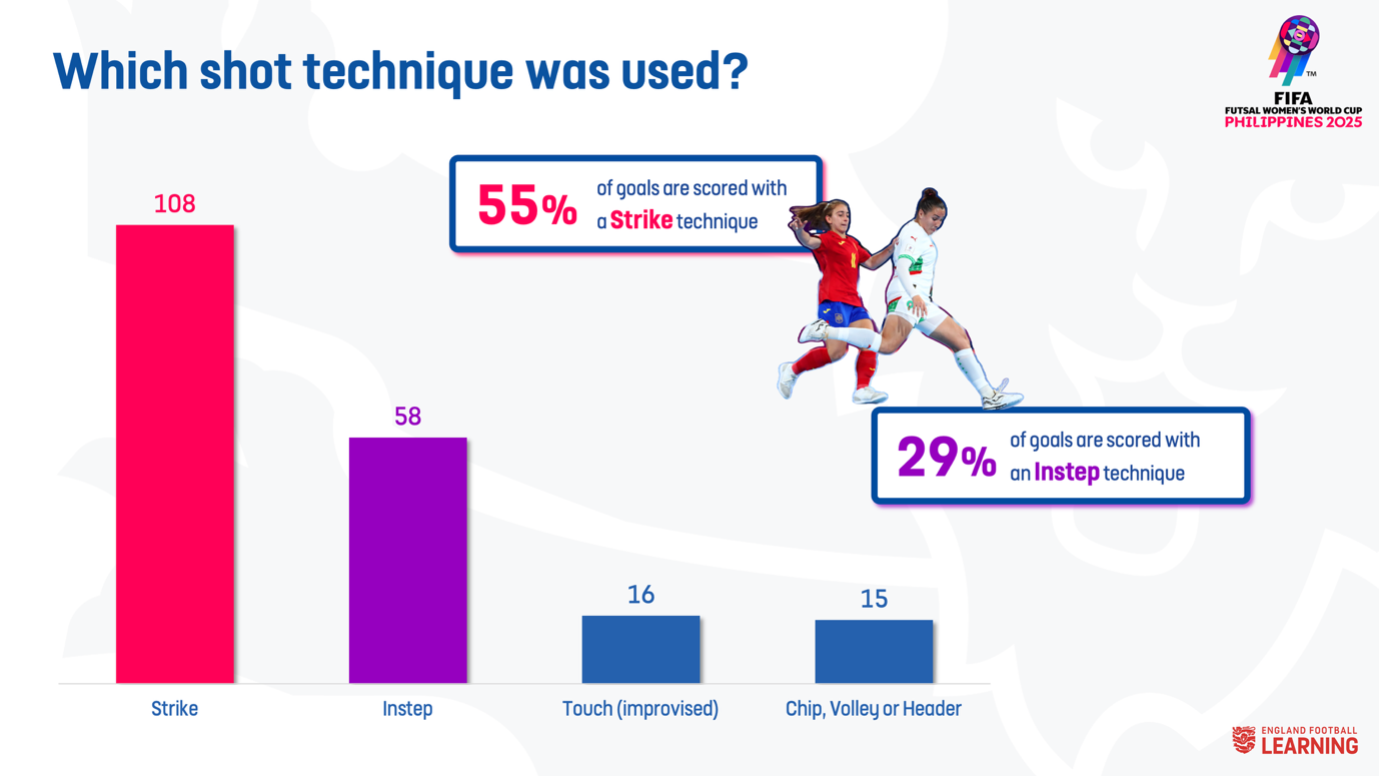
This image shows a bar graph of the different shot techniques used to score at the Futsal Women’s World Cup 2025, with Strike being the most used (108 times).
What does this mean for football?
- Emphasise strike technique and clean contact in finishing practices
- Create scenarios where players must finish through defensive traffic
- Design practices that encourage low, controlled finishes rather than always aiming for power
It is important to challenge your players to problem-solve when faced with a congested box, enabling their shot techniques to improve and vary in exposure.
Touches: speed in execution
One of the clearest patterns in futsal goalscoring is the speed at which finishing actions occur. Unlike football, where attackers may have time to control and adjust, futsal often demands immediate execution. The closeness of defenders, the reduced playing space, and the speed of ball circulation mean attackers rarely have the luxury of multiple touches before shooting.
At the futsal World Cup alone, 8 in 10 goals were scored with one or two touches, emphasising the increasingly limited time and space these players have to score goals. When we compare this number with last year’s Euros, an even clearer picture emerges.
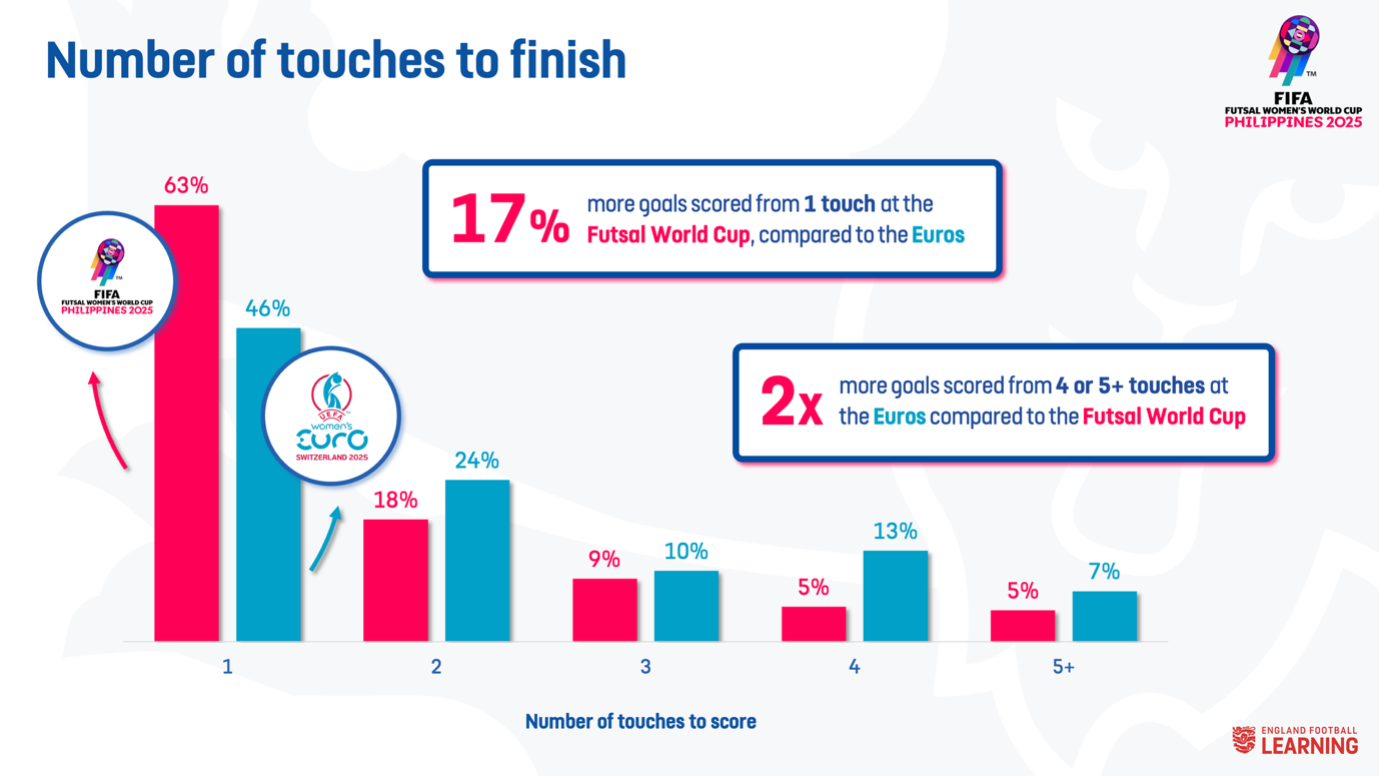
This image shows a bar graph comparing the number of touches taken to finish at the Futsal Women’s World Cup 2025 and the Women’s Euros 2025, with 17% more goals scored from 1 touch at the Women’s Futsal World Cup.
What does this mean for football?
- Condition games to limit touches in the final third
- Reward first-time finishes with double points
- Design practices where players must prepare their body shape before receiving
Minimal touches in practices are often viewed as a constraint, but futsal helps to teach us that they are a competitive advantage in critical moments of the game.
Location: movement without offside
The absence of an offside rule fundamentally changes how attacking players create space in futsal. Rather than relying on runs in behind the defensive line, attackers must constantly manipulate defenders through movement, timing and positioning around the edge of the penalty area.
45% of goals were scored centrally and inside the D at the futsal World Cup, leaving a quarter of all goals to be scored centrally just outside the D. In comparison, just 6% of all goals scored at the 2025 Euros were centrally just outside the box, as shown below.
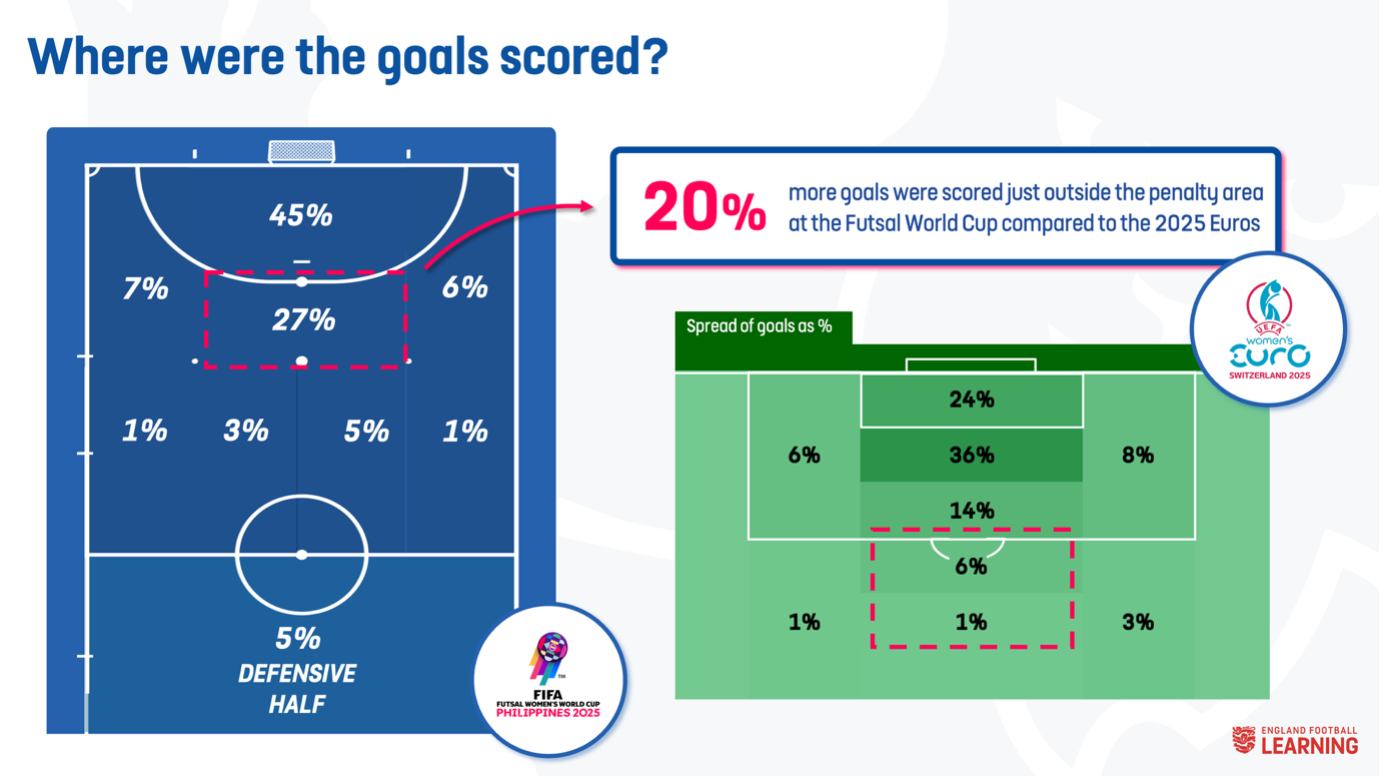
This image shows a comparison of the location of goals scored at the Women’s Futsal World Cup 2025, compared to the Women’s Euros 2025, with 20% more goals being scored outside the penalty area at the Futsal World Cup.
What does this mean for football?
- Consider coaching double movements around the edge of the box to create space
- Utilisation of late runs from deeper positions to create free players on the edge of the box
- Rotations that unbalance defensive structures and positioning
In football, offside serves as an additional defender. Futsal teaches attackers how to create space without the safety net, making it a good challenge for your players.
Exposure: repetition of finishing
Another major difference between football and futsal lies in how often players are exposed to finishing situations. The structure and pace of futsal naturally generate far more shots and scoring opportunities throughout a match.
In an 11v11 match, the average number of finishes per outfielder in 40 minutes is 0.8 finishes. In futsal, the average is 15 finishes, as shown in the graphic below.
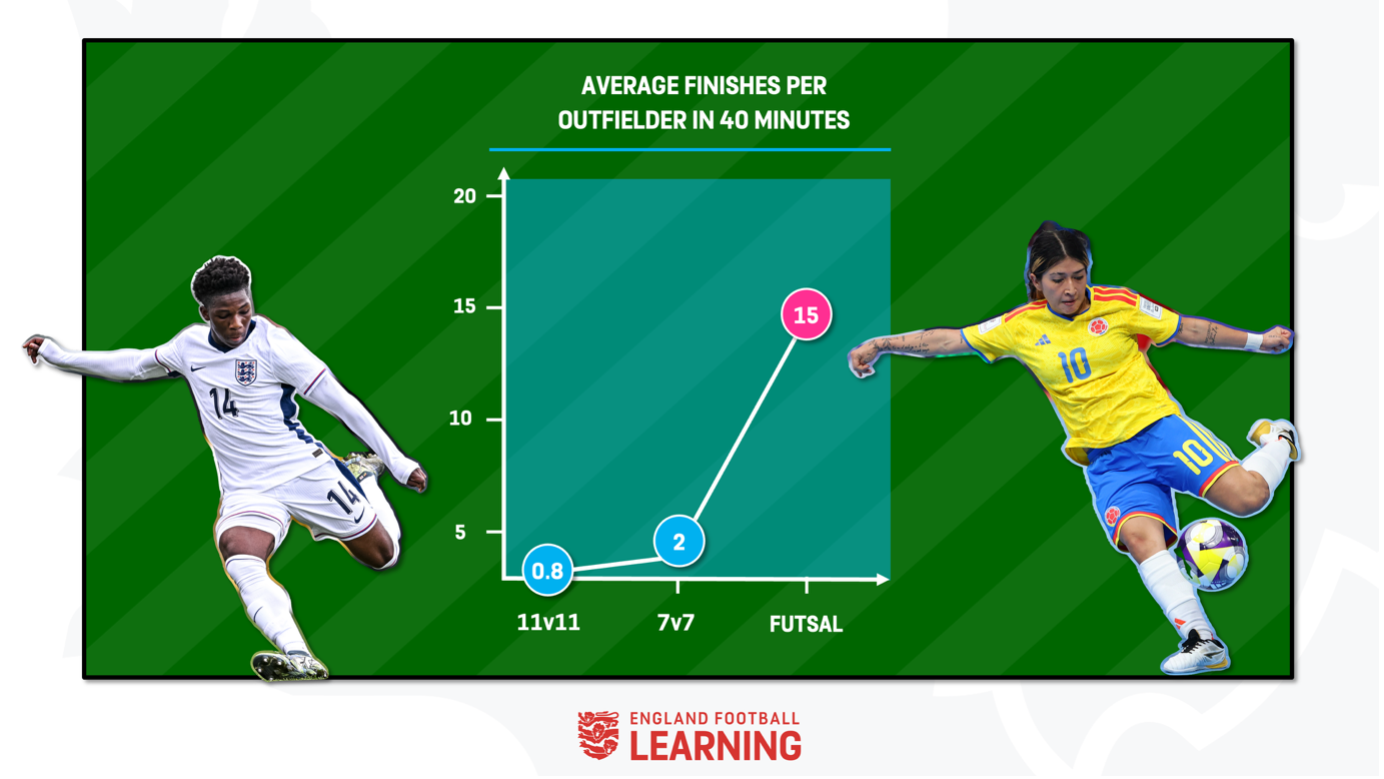
This image shows a table comparison of the average frequency of attacking core skills per player, per game at the Women’s Futsal World Cup, compared to the average seen in a 7v7 game, and an 11v11 game.
Why does this matter for football?
Skill development relies on repetition under realistic pressure. As a result, if your player is exposed to 15 finishing actions in 40 minutes, their technical and psychological skills are more likely to improve. If your players need to improve their finishing ability, you may need to artificially increase the volume of finishing they are exposed to, or embrace formats, such as futsal, that naturally do.
Check out the session design section below to see how you can take inspiration from futsal in your goalscoring practices.
Top tips: translating futsal into football practices
Here are 4 top tips to help you, as coaches, translate these insights into real-life football practices that can help expose your players to new ways of finishing.
- Increase finishing exposure
In many training sessions, opportunities to finish are limited. Consider using smaller-sided formats or quickly rotating positions so players experience multiple finishing moments within a short period.
- Reduce time and space
Introduce touch limits, pressure from recovering defenders, or smaller scoring zones. These constraints encourage players to prepare their body shape early and execute finishes quicker.
- Prioritise central finishing scenarios
Design practices where attacks frequently end in central areas of the penalty box rather than from wide, uncontested crosses. This mirrors where many high-value chances occur.
- Emphasise first-time finishing
Reward quick execution in games and finishing drills. For example, awarding double points for first-time finishes can encourage players to develop the confidence and technique required to shoot immediately.