



St. George's Park played host to the EE Disability FA Cup finals once again, providing a full weekend of football across the formats of the game, with partially sighted, blind, deaf, powerchair, cerebral palsy and amputee finals all decided. As ever, it was a showcase of the breadth and quality of disability football in this country, and of the individual moments and decisions that win finals.
Game Insights Analyst, Jess Saunders provides a round-up of the weekend’s action, including how Cambridge’s own TJ Yates used the 6 capabilities to be the star of the amputee final.
The weekend's results:
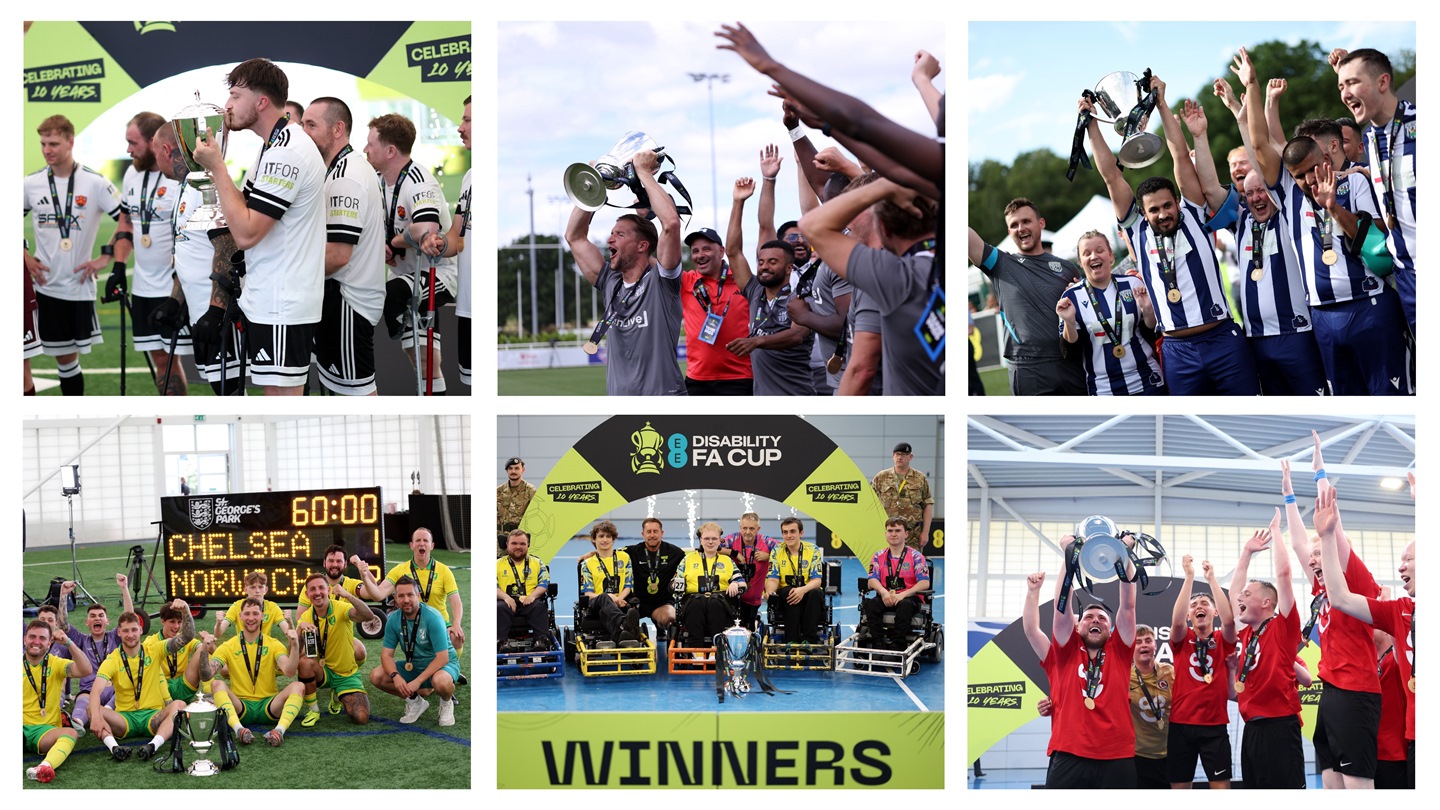
- Partially Sighted Futsal Cup: Bolton Futsal 4-4 Birmingham Futsal (Bolton win 3-2 on penalties)
Bolton Futsal survived one of the games of the weekend in the Partially Sighted final, racing into a 4-1 lead before Birmingham's Danny Gauden completed a hat-trick and Andy Lang levelled it at 4-4 with a stunning outside-of-the-foot strike inside the final minute; only for Bolton to hold their nerve and win 3-2 on penalties through Lucas McClay
- Blind Cup Final: Royal National College for the Blind 2-5 West Bromwich Albion Blind
West Bromwich Albion Blind** were ruthless in their 5-2 win, with Eesa Amjid and a hat-trick from Efe Shimwell, much of it from set pieces, putting the game beyond Royal National College.
- Cerebral Palsy Final: Chelsea FC Foundation 1-2 Norwich City Community Sports Foundation FC
Norwich City dug in for a 2-1 Cerebral Palsy final win over Chelsea. Headers from Karl Townshend and Reegan McMillan turning the game before they defended superbly with ten minutes a player down after a sending-off, edging a series that now stands 2-1 in their favour.
- Powerchair Final: Leeds PFC 3-1 Teesside PFC
In an all-debutant Powerchair final, Leeds PFC beat Teesside PFC 3-1, captain Dylan Kelsall scoring twice and Dan Rigby weighing in with an assist and a goal to claim a first-ever title.
- Deaf Final: Barnet Deaf FC 2-3 St. John's Deaf FC (a.e.t.)
And in an all-North-London Deaf final repeat, **St. John's Deaf FC** came from behind in extra time, Byron Down's acrobatic equaliser and his assist for captain Jamie Clarke sealing back-to-back titles against Barnet.
- Amputee Cup Final: Cambridge City 3-2 Chelsea FC Foundation (a.e.t.)
The Cambridge City fairytale, analysed below.
Cambridge City: five months in the making
Of all the stories from the weekend, none was quite like Cambridge City's. The club's amputee side was formed barely five months ago, yet they walked off the St. George's Park pitch as EE Disability FA Cup champions.
In the final, Chelsea FC took the lead just before the break in the first half, Sofyan Filali finding the bottom-left corner with a clinical finish after Harry Ash and others had tested the Cambridge defence. Cambridge had gone close to themselves; a header from a superb cross drifted just wide in 20 minutes but trailed 1-0 at the interval. What followed belonged to one man.
TJ Yates: a hat-trick through the six capabilities

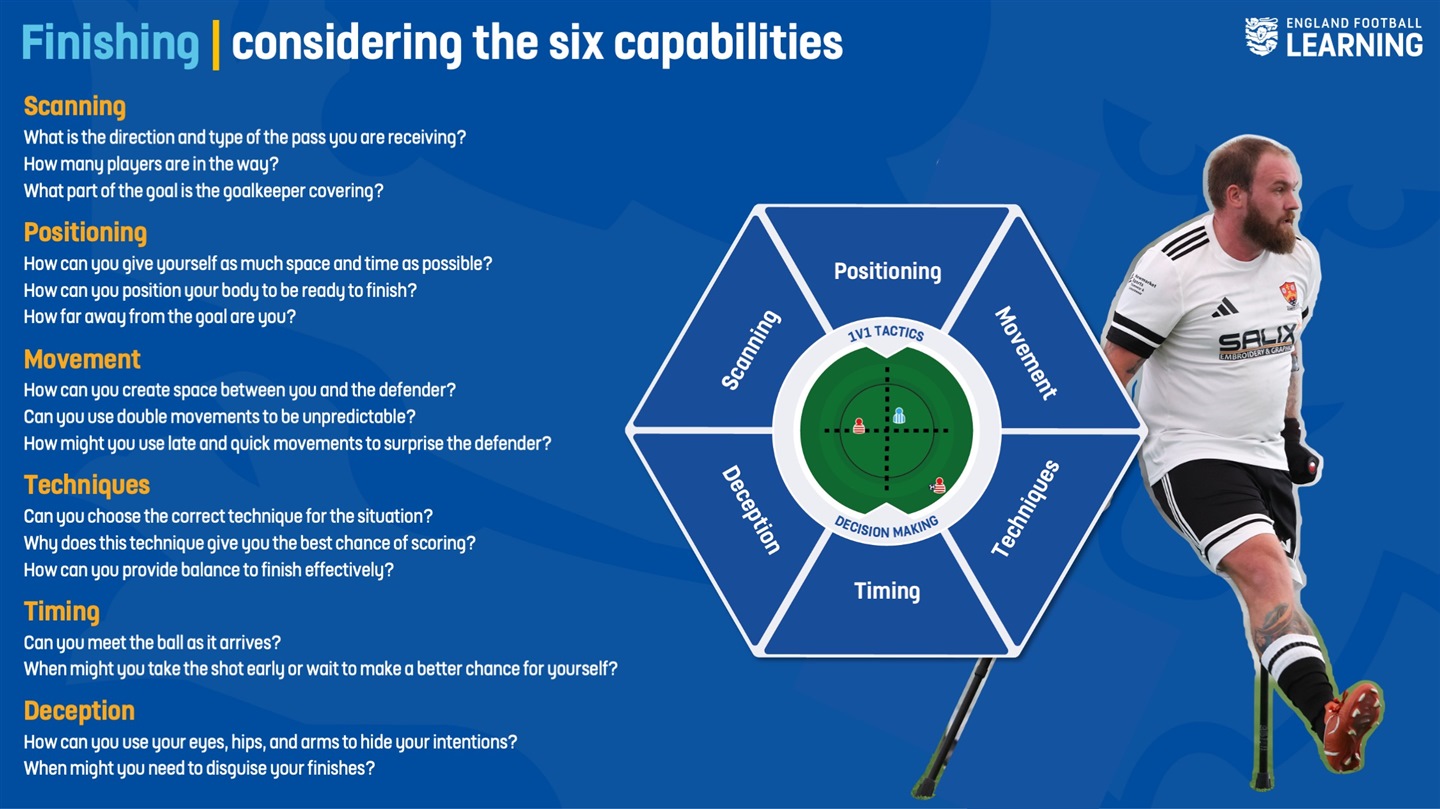
The Player of the Match didn't score three of the same goal. Each of TJ Yates's finishes drew on a different blend of the six individual capabilities: Scanning, Timing, Movement, Positioning, Deception and Technique.
Goal 1: 49 mins, 1-1
- Scanning - Yates tracked the flight of the ball early and scanned the space around him before it arrived.
- Timing - He delayed his run to the exact moment the ball dropped into range, taking the strike first time.
- Movement - Using his power on the crutches, he was able to readjust his movement to get back in line with a ball after it was played behind him.
- Positioning - That readjustment put his body square to the ball and set him up to attack the bottom corner.
- Deception - By checking his run to match the flight of the ball, he wrong-footed the defenders and bought himself a yard of separation.
Goal 2: stoppage time, 2-1
- Scanning – Yates picked up the higher, deeper flight of the cross early and scanned for defenders around him, around the area where the ball would drop.
- Timing - Rather than waiting for the ball to come to him, he judged the moment to attack it, meeting it with his head at its highest point.
- Movement - He travelled onto the cross, allowing him to run onto the ball rather than waiting for the ball to come to him.
- Positioning - He got himself above and behind the ball so he could head it down rather than across or up.
- Deception - His late, decisive run gave the defenders no time to track him and adjust.
- Technique - He directed the header firmly downwards into the bottom of the goal, with both power and accuracy..
Goal 3: extra time, 3-2
- Scanning - As the Chelsea keeper rolled it out, Yates had already scanned around, giving him the awareness to read the situation and press to win the ball.
- Timing - Yates recognised the trigger of the bad pass and pressed instantly, exploiting the moment of hesitation.
- Movement - He closed the gap quickly, driving onto the loose ball before the defender could recover.
- Positioning - He got his body in front of the ball first, winning the possession.
- Deception - His sudden change of intent, from holding off to pressing, caught the defender unprepared and forced the goalkeeper to panic.
- Technique – It took just a single touch around the goalkeeper to win the game.
Check out the graphic below to consider how your players can finish effectively using the 6 capabilities in your own environments.
Congratulations to all of the winners and finalists across the weekend, and to everyone who made the 2026 EE Disability FA Cup finals exciting, inspiring and full of talent.