



The high press remains one of the most talked about out-of-possession strategies in the modern game. Designed to regain possession close to the opposition goal, a high press can disrupt an opposition’s build-up and even create goal-scoring opportunities.
There are a large number of teams across both the male and female game that adopt a high press as their main out-of-possession strategy. But what do these look like? Why are they heavily talked about? And why have they been so successful?

Game Insights Analyst Jess Saunders dives into these questions below, exploring the key trends and tactical details that underpin teams that high press.
What is a high press?
A high press is an out-of-possession strategy in which a team applies pressure in the opposition’s defensive third to try and win the ball high up the pitch. This strategy can be used to win possession closer to the opponent’s goal, force mistakes, and lock opponents to a particular side of the pitch. Each of these can be used to create immediate attacking opportunities A high press usually means the players are having to work hard out of possession, with a lot of sprints and high-speed running.
Why might you use a high press?
Whilst pressing high up the pitch is a big topic of conversation in recent years, it isn’t simply a talking point. When used appropriately, it can be a powerful tool for engaging your players, giving them clear roles that encourage teamwork, intensity and communication.
It has also provided a lot of success for teams across the elite level of the game. Check out this season’s high press statistics from the Premier League and Women’s Super League (WSL) so far this season.
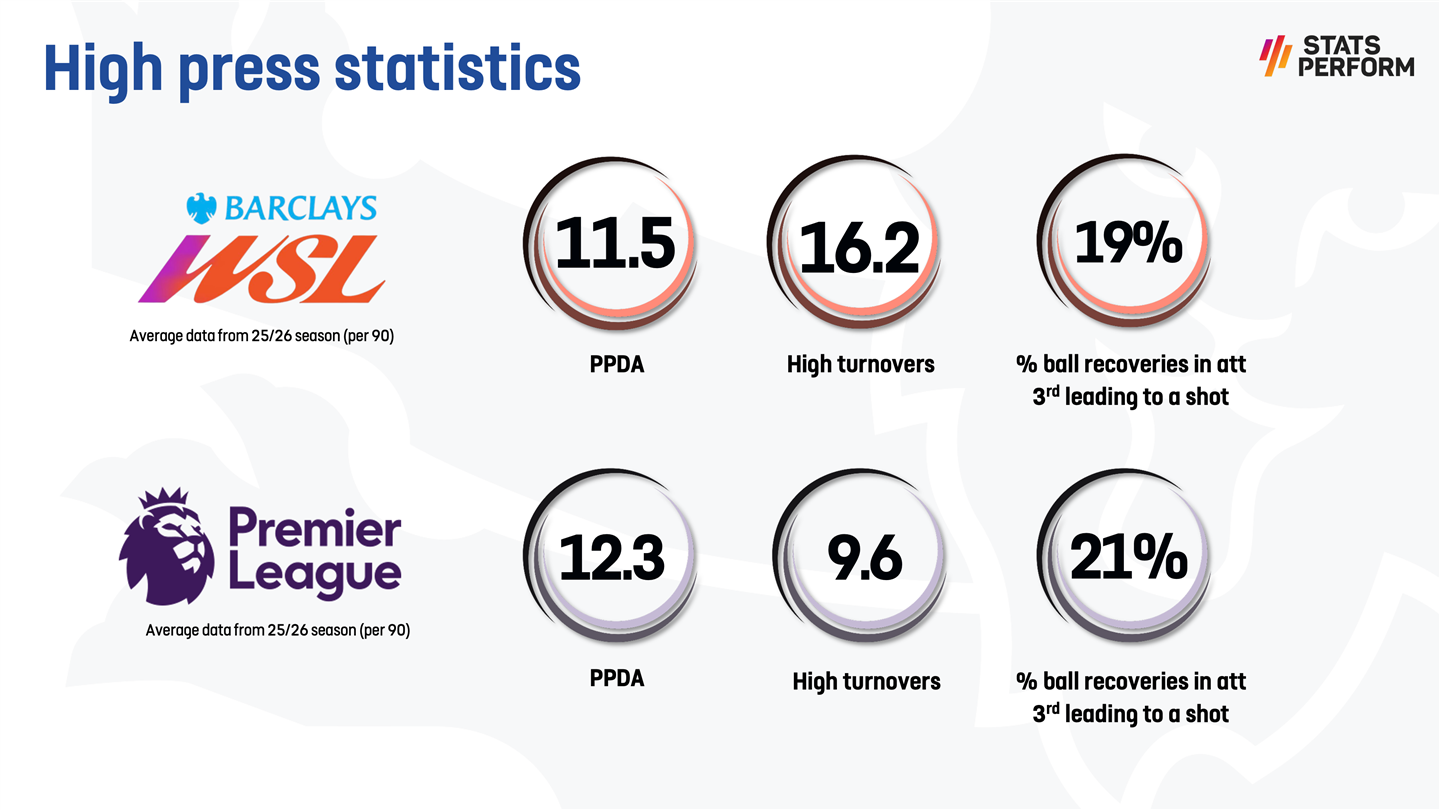
A graphic showing key high press statistics from both the Women’s Super League 25/26 and the Premier League 25/26. PPDA = number of passes allowed per defensive action. High turnovers = number of possessions regained in the attacking third.
And it doesn’t stop there. From a tactical perspective, pressing high offers several advantages:
- Closer to the goal when possession is regained.
- Disorganised opposition.
- More opportunities to create goal-scoring chances.
- Level of control without dominating possession.
- Psychological and physical pressure on defenders and goalkeepers.
Despite the obvious risk a high press can pose if exploited, it has been widely adopted in the game and means there is an even greater importance of having the right structure, timing, and individual capabilities to execute it effectively.
Two teams that have shown success in this season’s WSL are Chelsea and London City Lionesses. Two teams with very different pressing strategies, but both equally as effective. Check out how they achieve their success in the videos below.
Chelsea Women’s 25/26 relentless high press
Chelsea’s high press reflects a team comfortable operating almost permanently in the opposition half. Their strategy allows them to overload central areas, creating traps in wide areas to force mistakes or regain the ball. Their ability not only to recover the ball high up the pitch but also to turn those recoveries into key chances at goal has excelled Chelsea’s out-of-possession work.
Example practice: how could you use this strategy with your team?
Chelsea’s high press is a great strategy to use if you:
- Have players that are energetic and willing to work together – this strategy suits teams that have good effort levels and communication.
- Want to win the ball closer to the opponents goal – this strategy allows you to regain possession in dangerous areas, making it ideal for teams that may struggle to build the ball through the thirds.
- Want to control the game without wanting constant possession – this strategy suits teams that like to dictate to opponents on where and how the game is played.
Not sure if that would work for you? Watch how London City Lionesses implement their high press strategy to see if this could work for you.
London City Lionesses' selective high press
As a newly promoted side, London City Lionesses adopt a more selective high press, designed to maximise impact while managing risk. They hold their second line of pressure, keeping distance from the opposition to entice the ball into certain areas and force a mistake.
Example practice: how could you use this strategy with your team?
London City Lionesses’ high press is a great strategy to use if you:
- Want to press with a purpose- this strategy helps save your players some energy whilst still creating moments to win the ball high up the pitch.
- Have players that understand pressing triggers – this strategy can be successful when players recognise poor touches, backward passes or wide passes as triggers to press together.
- Want to reduce risk whilst still forcing mistakes – this strategy means you can invite the opposition into specific areas of the pitch without leaving large spaces behind.
Want more insight? Keep reading to pile the pressure on!
Two different strategies with the same success
Chelsea entered this season as six-time WSL champions, with a squad built on in-game dominance. London City Lionesses, by contrast, are newly promoted, adapting their pressing strategy to compete at the highest level. Despite their different contexts and expectations, both teams arrive at very similar pressing outputs.
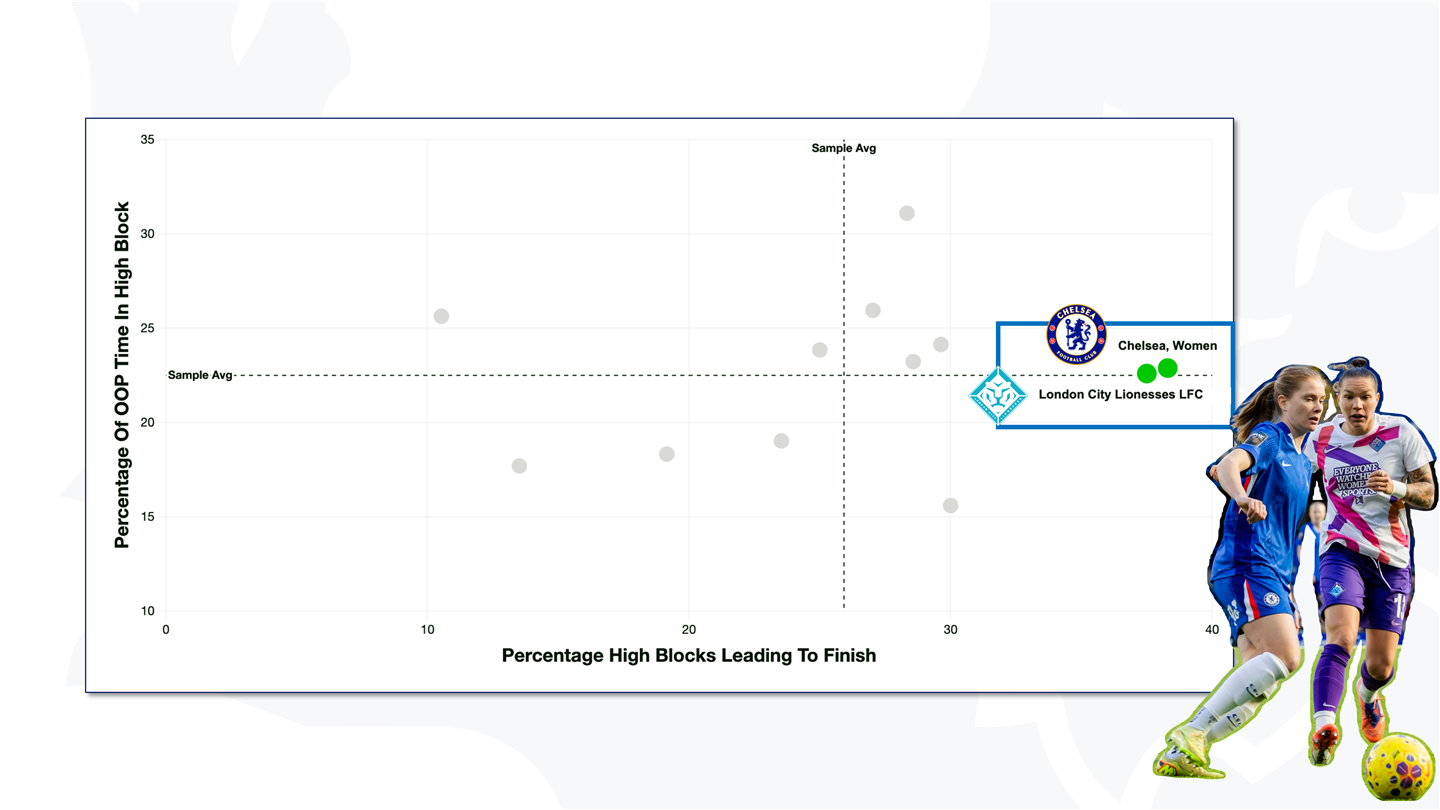
This graph shows the percentage of all WSL 25/26 teams’ high presses leading to a goal, and the percentage of out-of-possession time spent in a high press. Chelsea Women and London City Lionesses are highlighted as standout teams on the graph.
This graphic shows both teams’ high success rate in converting a high press into an attacking opportunity. However, as seen earlier, they operate very differently tactically. Therefore, when considering which strategy might work for your team, it is important to understand your own context and your players’ individual capabilities.
If you want to learn more about the best decisions you can make for your team, along with individual capabilities linked to a high-press, click here to join our next webinar and send in your questions! CLICK HERE!
Coaching Considerations:
- How do you observe your players’ individual capabilities in order to assess the best pressing strategy for your team?
- What behaviours do you coach immediately after regaining possession? What does their decision-making look like?
- How adaptable is your high press across different game states and opposition?