



The 2026 FA Cup final saw two Premier League heavyweights clash in a tactical masterclass. Manchester City avenged their 2025 FA Cup final loss to Crystal Palace by beating Chelsea 1-0. The push and pull of each team across the game eventually led to a genius finish from the man of the match, Antoine Semenyo. When few goals are scored, we can look at the finer details of where games are won and lost.
Game Insights analyst Luke Saunders focuses on in-game decision-making and individual tactics.
Manchester City win domestic cup double
The FA Cup final was the third meeting between Manchester City and Chelsea in 2026. In January, Manchester City drew 1-1 at home to Chelsea, before they travelled to Stamford Bridge in April and won 3-0. The third instalment of this rivalry was always going to be a close one. Not only was there silverware on the line, but also because the teams had very recent experience of playing against each other. When teams become familiar with each other, it is the small margins that can win games.
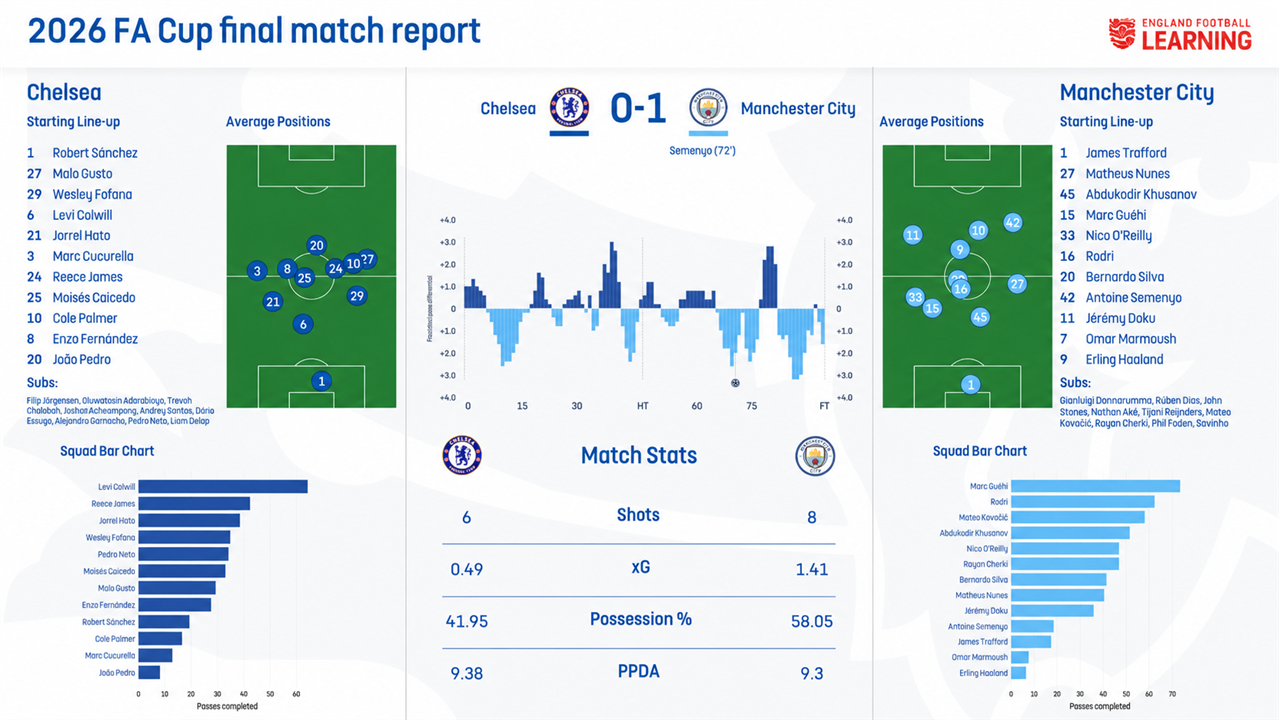
Pep Guardiola’s in-game decision making
Understanding the environment and atmosphere the players are playing in is key to appreciating how this might affect individual and team decision-making. Tactical decisions at different game states and moments can have varying levels of impact. In this game, a standout moment was Rayan Cherki being substituted on for Omar Marmoush at halftime.
Cherki’s introduction meant that Haaland had a runner when he dropped deeper into midfield. The centre midfielders also narrowed up and moved slightly higher up the pitch. In contrast to this, City’s centre-backs dropped deeper. These subtle changes had many effects, including:
- Drawing Chelsea out to press higher up the pitch.
- Midfielders running in behind Chelsea, especially in the central lanes, between wing backs and centre backs (this is where the goal came from).
- Haaland dropping into midfield to either create overloads and receive the ball or drag the opposition centre backs out of position with his movement.
Look at the below image to see how City’s players’ average positions changed from the 1st half to the 2nd half.
%20Men's%20FA%20Cup%20Final%202026/City%20avg%20positions%20with%20blue%20circles.png?csf=1&web=1&e=EMj8Av)
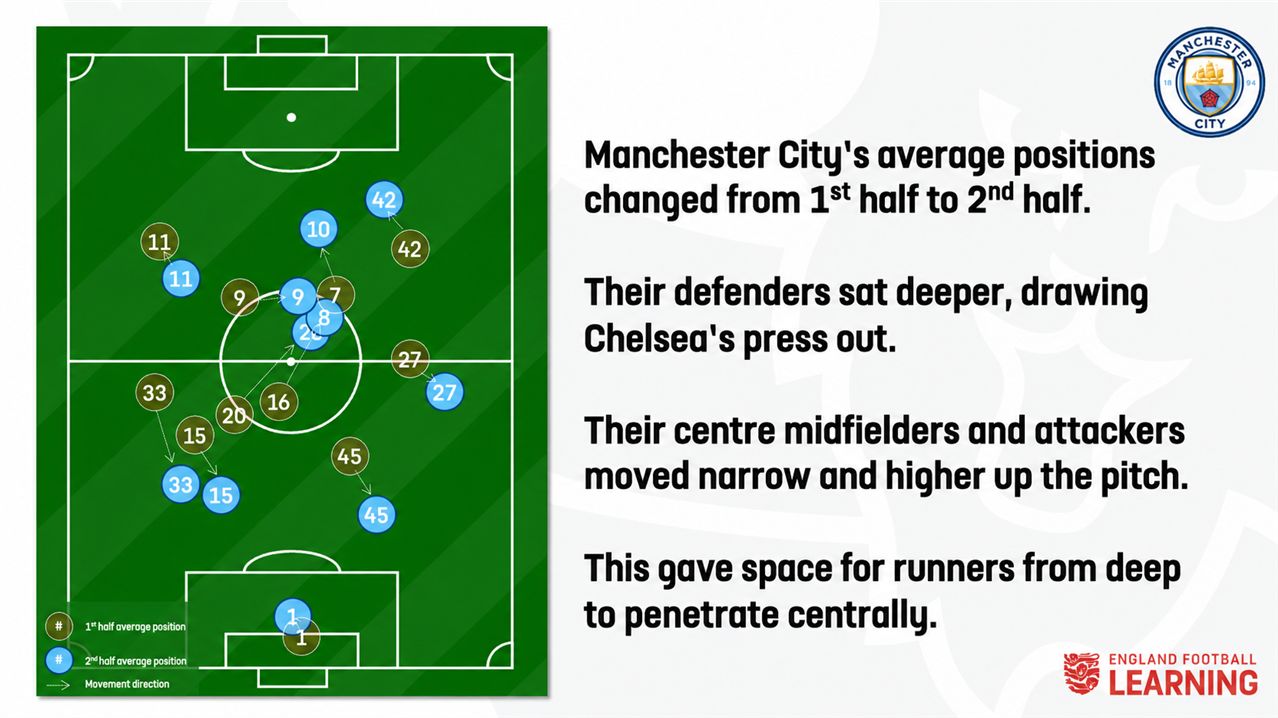
Rayan Cherki (10) moved out to the right side to combine with Antoine Semenyo (42) and Matheus Nunes (27), recognising the space between Marc Cucurella (Chelsea left wing back) and Wesley Fofana (Chelsea left centre back) as they were pressing higher up the pitch. This forced Chelsea’s centre backs to swing across and position themselves more aggressively, leaving spaces for City to exploit. Midfield runners inside and beyond Chelsea’s centre backs were dangerous and this is where City’s goal came from.
Decisive individual tactics
“Since he arrived, Antoine has had a sense of goal. It was a little swap, normally he crosses to Erling [Haaland], but he has that sense and it was a really good goal.”
Pep Guardiola recognises Antoine Semenyo’s “sense” and his ability to score excellent goals. Supporting our players to recognise not only their strengths and weaknesses, but also their opponents’, can be the difference between winning and losing a cup final.
Guardiola’s tactical tweaks at half time gave Antoine Semenyo more chances to isolate defenders and move into space. His match winning goal highlighted a selection of his powers:
- Strength to hold off Wesley Fofana and link-up in the create the attack phase.
- Speed and awareness to turn and move into the space left behind Marc Cucurella after he has been dragged out to press in the middle third.
- Intelligence to move into the 18-yard box, knowing he isn’t being marked.
- Skill to twist his body and finish first time with a flick off his right foot from Erling Haaland’s cross.
Look at the goal below to see those abilities in action.
Our players may only get 1 or 2 opportunities to showcase their strengths in a game. It is a coach’s skill to ensure that their players are in the right position to be able to execute and they are being supported by their team’s tactics and strategies.
Coaching considerations – Q & A
Q: How do we observe what needs to change in a game for our team to be more successful? How do we then make these changes and when do we act on them?
A: Effective observation requires effective collaboration and communication across an MDT. If possible, share roles and responsibilities with others so that you can focus on specific things, rather than trying to cover everything. Deciding how and when to act depends on the context. You may wait for a certain trigger before acting or may decide that you cannot risk waiting any longer so you act quickly.
-
-
Q: If our opponents have made a tactical change, how do we recognise this in-game? Who’s responsibility is it to recognise, decide and then act on a response?
A: Sometimes our opponents will act quicker than we do. Again, it is important to establish clear roles and responsibilities across your MDT or whoever may be supporting you on the sideline. Who is their danger player? What formation are the opponents playing in? How are they getting out of their own half? You could take advice and considerations from others and then decide on the best course of action. Sometimes this is information passed on from an analyst, goalkeeper coach or even a parent on the sideline. Don’t forget that your players on the pitch are living and breathing the game. They’ll be seeing things and will have ideas on how to respond.
-
-
Q: How can we provide a platform for our players to showcase their individual tactics? Does one player’s super strengths require another player to support them by playing a different role?
A: Supporting players and encouraging them to discover and platform their individual tactics starts in the practice sessions. Are our players encouraged to be creative and explore their abilities, or are they set to structure and routine? Encourage your players to experience playing in multiple positions so that they are diversifying and discovering their skillset. This will also allow them to support their teammates when their role during the game is different.