



The moment where possession changes from one team to the other is called a “transition”. Finding structure within these chaotic moments can increase the chances of scoring a goal. For example, quickly exposing the opponent’s defence when they are disorganised following a possession turnover. Game Insights analysts Luke Saunders and James Cook explore how teams use transitions which begin in the middle 3rd of the pitch to create goalscoring opportunities.
Possession starts – turnovers in the middle 3rd
With each team having played at least 27 games, we are 2/3rds of the way through the English Premier League season. At this stage, 70% of possessions start with a turnover in possession. Look at the image below to see the breakdown of possession starts this season.
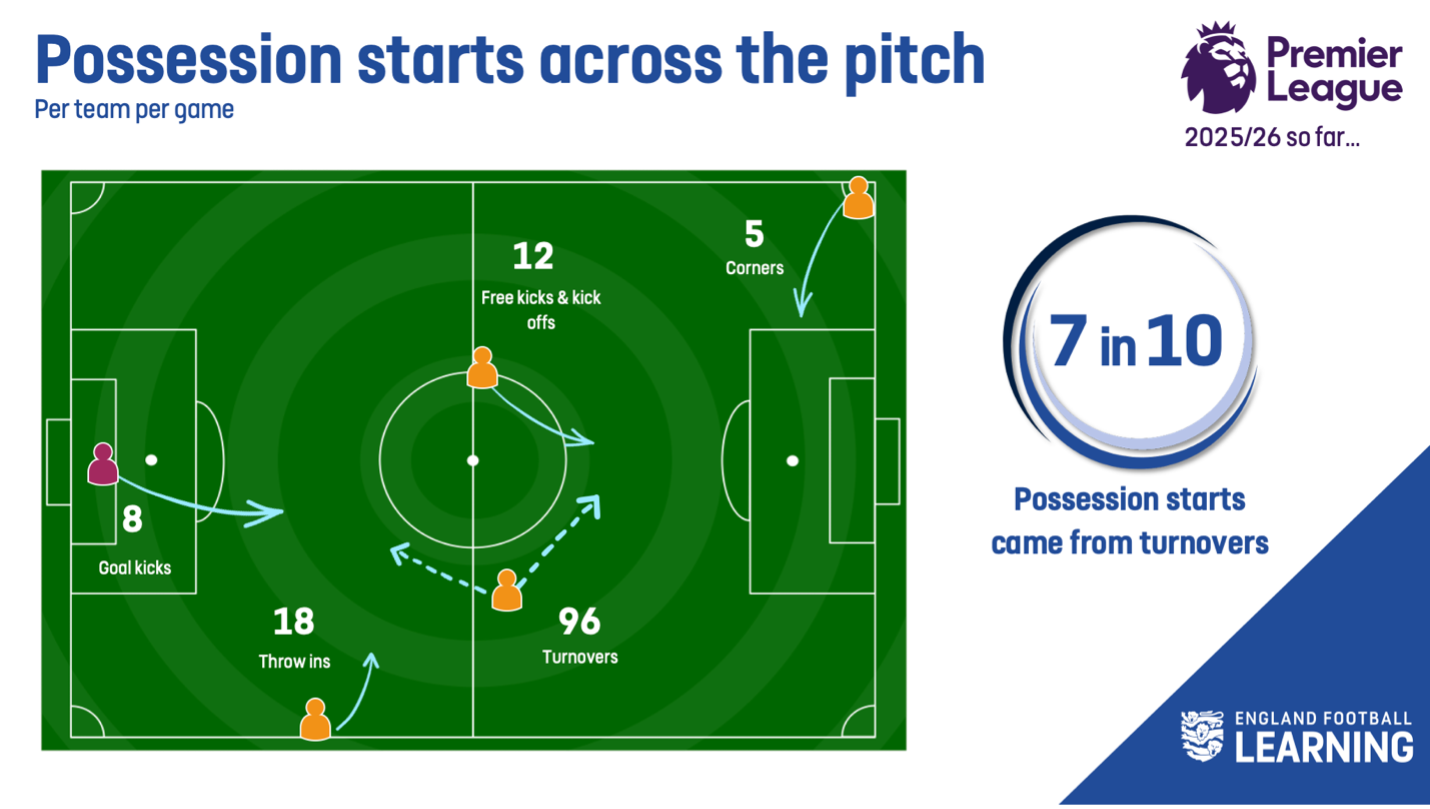 This image shows the frequency of different possession starts per team for each game. The data comes from the 2025/2026 English Premier League season. Correct as of 24th February 2026.
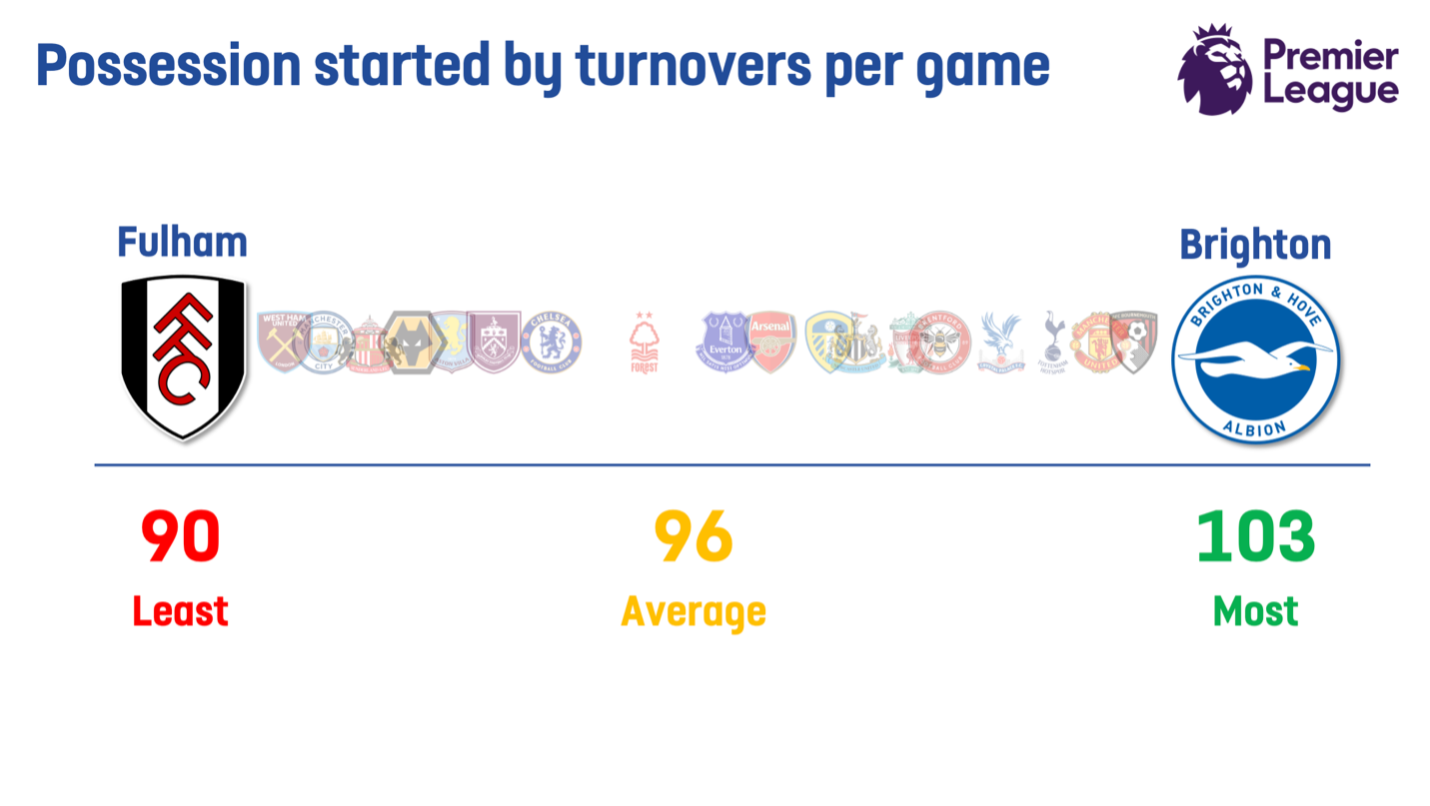
This image shows how many turnovers each team has per game. The data comes from the 2025/2026 English Premier League season. Correct as of 24th February 2026. Fulham have the fewest turnovers per game (90) and Brighton have the most (103). There is not much variation from the average.
Possessions that start with a turnover usually then begin a transition. If we zoom in a little further, there are:
- 35 transitions starting in the defensive 3rd (1 fewer than last season).
- 41 transitions starting in the middle 3rd (3 more than last season).
- 21 transitions starting in the middle 3rd (the same as last season).
The middle 3rd stands out. 76% of possession starts in the middle 3rd are transitions. It is the 3rd with the most possession starts, the most transitions and these have both increased compared to last season’s averages.
Why should we turnover the ball and transition from the middle 3rd?
There are many benefits to drawing a team to the middle 3rd of the pitch, winning possession and then transitioning to attack. These include:
- Drawing the opponents out to create more space behind and through their defence to attack after regaining possession.
- Attacking either quickly to exploit the disorganised defence or combining with teammates who are nearby due to the compact defensive shape.
- Reduces the space between our team’s lines so that our team can remain in a compact, defensive shape.
What does it look like?
Transitions from the middle 3rd happen at every level of the football pyramid. Watch these clips from the FA Cup to see how Chelsea and West Bromwich Albion use speed to attack in transition from the middle 3rd.
How can I practice possession turnovers and then transitions to attack? (session plan video)
Take a look at the session plan below to give you an idea of how you can practice winning possession back in the middle of the pitch and then starting a transition from defence to attack. If you can move the ball quickly and exploit the disorganised defence, you’re likely to be in with a great chance of scoring a goal.
Tips for coaching this with your team
- Incentivise middle 3rd transitions to encourage turnovers in targeted zones.
- Encourage the yellow striker to make central runs between the blue defenders.
- Encourage the yellow wide players to make diagonal runs towards goal.
- Encourage yellow centre midfielders or defenders to play forwards quickly after the turnover.
Want more?
Take a look at another transition session:
Transition session: transition to attack
Watch a coach developer deliver a counter-attacking session:
Transition And Counter-Attacking | FA Learning Football Coaching Session From Gordon Staniforth