



The first-ever FIFA Women's Futsal World Cup provided a new global stage for elite women's performance. Brazil, a nation deeply rooted in futsal's rhythm, rose to the occasion. They finished the tournament undefeated, extending their world-record run of 42 successive victories. Brazil's Emilly Micaela Marcondes picked up both the Golden Boot and Golden Ball. This domination showcased a winning blend of tactical mastery and individual creativity.
Game Insights analyst Jess Saunders explores Brazil's impressive achievement in this blog, breaking down how they used key attacking and defensive principles in the final against Portugal.
If you would like more information on what the attacking and defensive principles are, please read this article first: What are the principles of play?
Brazil's journey through the tournament
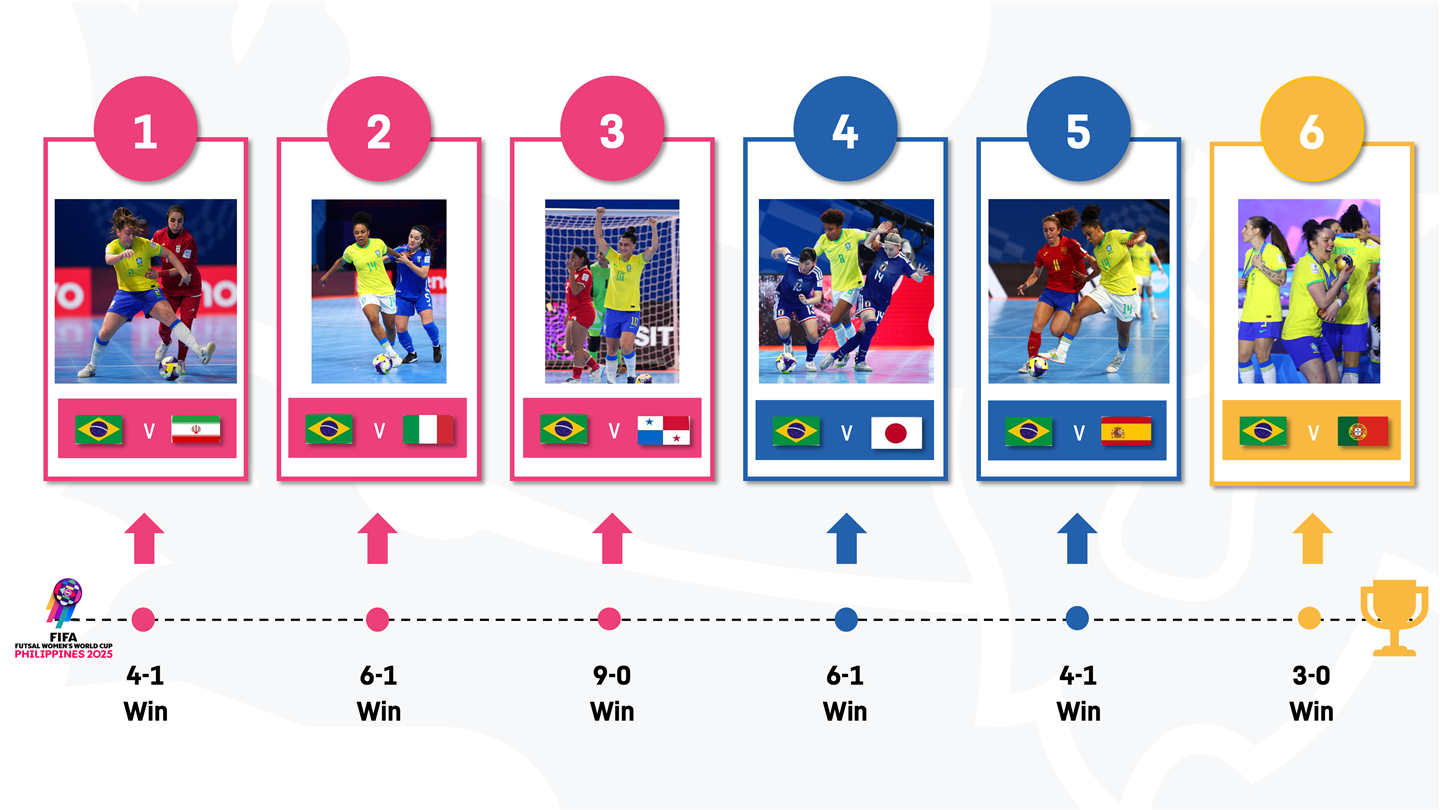
This image shows Brazil's journey through the tournament across a timeline, with the result and an image from each game, all the way to the final. Photo credits to Getty Images.
It is no secret that Brazil are well known for their creativity and flair across all formats of the game but less spoken about is the quality of tactical awareness on the biggest stage. The group stages were all about controlling the space and creating chaos. At the same time, the knockouts provided an opportunity for their management of pressure and playing with intent to shine.
The final was where they shone the brightest, executing key principles of play with brilliant patience and capitalising on opportunities where mistakes were made. It was in these moments that they scored the three decisive goals that secured the title.
The Final: Brazil 3-0 Portugal
Heading into the final, Brazil had scored 29 goals, conceding just 4. That's less than a goal a game! In the final, they increased their goal tally to 32, surpassing any other team at the tournament, with an average of 5.3 goals per game.
Brazil's dominance in the final was clear. Still, their ability to use the key principles of play elevated the quality of goals they scored. Whilst their second goal was a neat finish from a rebound, their first and third goals provide perfect examples of using both attacking and defensive principles of play to create chances.
Attacking principles of play leading to a goal
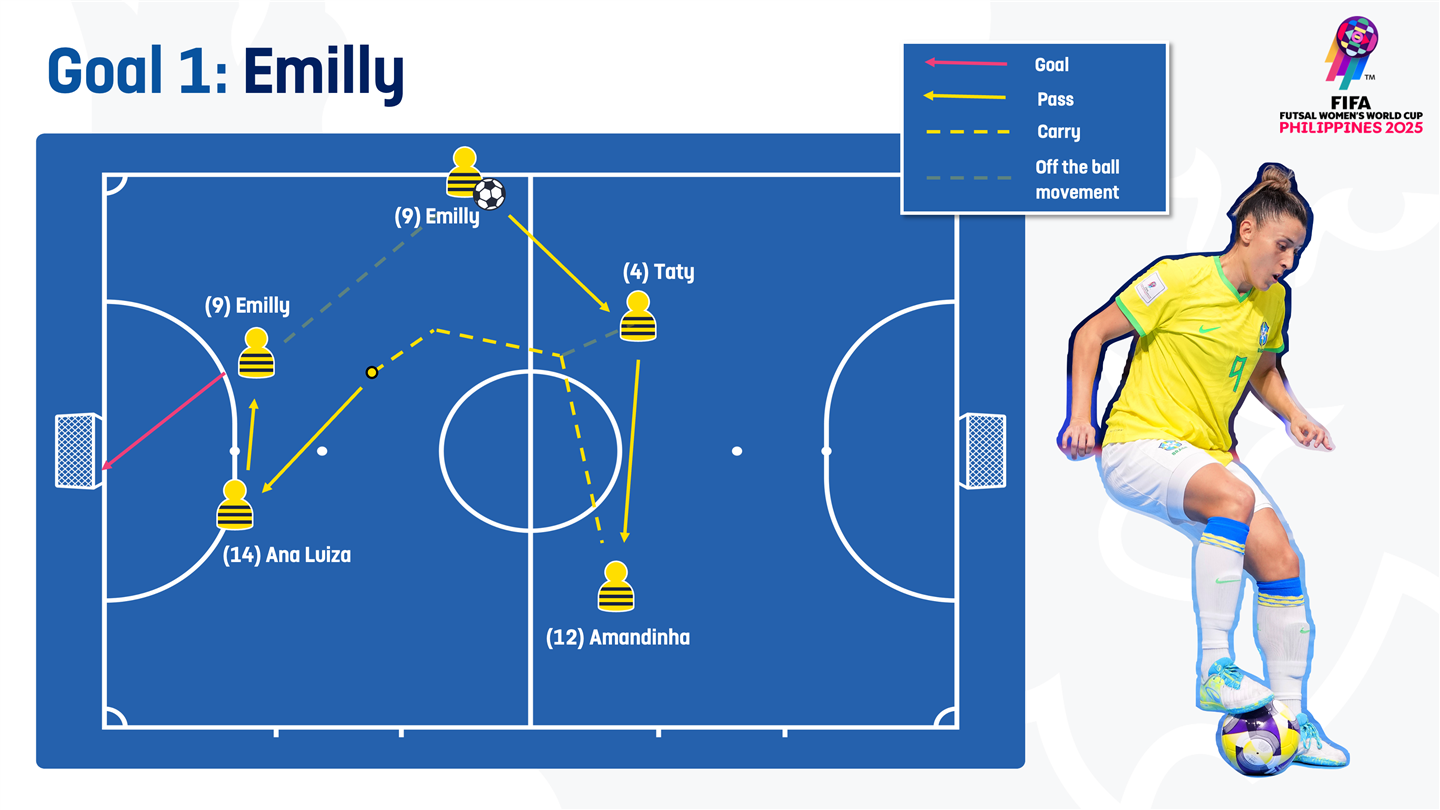
This graphic shows the passing sequence of Brazil's first goal on a futsal court, scored by Emilly, with a key explaining the meaning of the different types of lines.
- Creating space: Once Taty (4) passes the ball, she moves into a central area and uses one of futsal's best-used core skills, a block, to take a Portuguese player out of the game, creating space for Amandinha (21) to carry into without pressure.
- Penetration: When Amandinha (12) receives the ball, she carries the ball into the attacking half, beating Portugal's first line, and plays a penetrative pass into Ana Luiza (14) that breaks Portugal's second line.
- Creativity: As Amandinha (12) carries the ball, she uses her creativity to deceive a Portugal player by faking a pass wide and then rolling the ball inside. This frees her from pressure and gives her the space to find the next pass.
- Movement: To receive the ball, Ana Luiza (14) employs brilliant deception in her movement, coming towards the ball before making a backwards movement back to her starting position. This allows her to break free from the player marking her. Emilly's (9) movement from the back post area into a central position enables her to stay undetected. It gives her the space to take the shot first time when she receives the ball.
- Providing support: Emilly's (9) movement provided support for Ana Luiza (14), who was initially isolated with the ball.
Use this link to watch the goal here: Attacking principles of play on show
Defensive principles of play leading to a goal
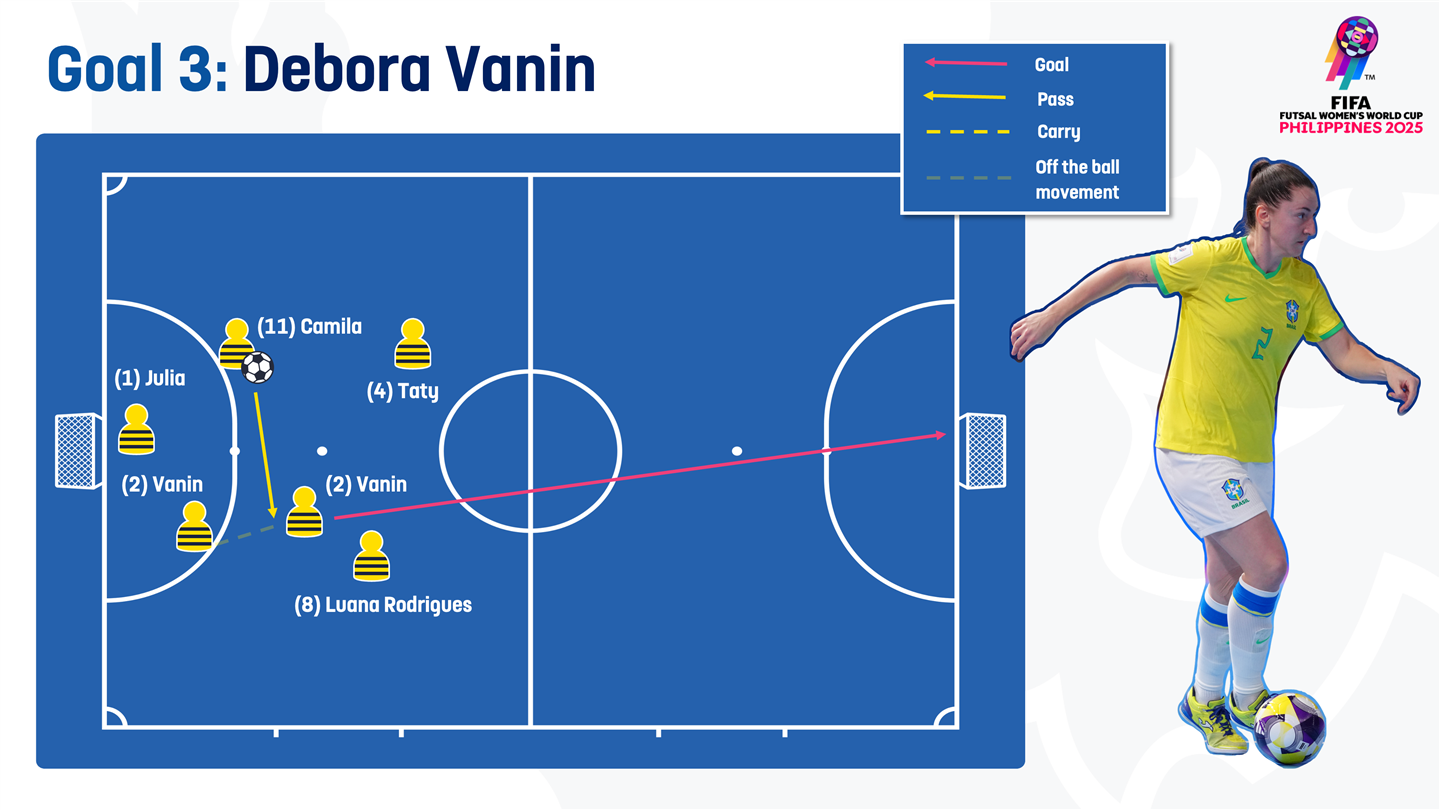
This graphic shows the passing sequence of Brazil's third goal on a futsal court, scored by Debora Vanin, with a key explaining the meaning of the different types of lines.
- Compactness: All 4 outfield players sit in a deep box shape, staying compact to reduce the inside space Portugal had when attacking.
- Delaying: As Portugal passed the ball across the court, Brazil's outfield 4 stayed compact in their position. This allowed them to delay the player and ball from moving forward with discipline, without jumping out to press straight away.
- Pressing: Luana Rodrigues (8) uses a smart press to block the line of sight of the Portugal player on the ball, having a greater impact on the player rather than the ball. This allows for an inaccurate pass that can be intercepted.
- Cover and balance: When Luana Rodrigues (8) moves to close the ball down, Camila (11) moves inside to cover the space left by her teammates' press, allowing her to intercept Portugal's pass.
- Control and restraint: At this late stage of the game, the Brazilian players acted with clever control and restraint. They pressed at the right moment while also maintaining their position and using the turnover to score the tournament's final goal, providing an example of good decision-making.
Use this link to watch the goal here: Defensive principles of play on show
What does this mean for all coaches?
- How do your sessions encourage players to manipulate defenders through movement and deception, including double movements and rotations to receive the ball?
- How often do you apply key defensive principles to link your own attacking outcomes in transition?
- How often do your sessions encourage players to carry the ball to commit defenders before playing a penetrative pass or shot?
- Do your sessions expose players to situations where restraint and game management are required late in matches?
Interested in learning more about futsal? Click the following links for more information, courses and resources: